German Atlanticism and the Sorry Fate of Ostpolitik (2)


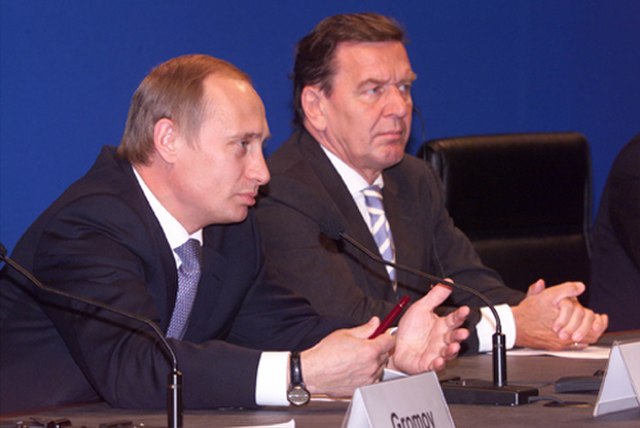
Remarkably, the reunification of Germany did not mark the end of Ostpolitik; on the contrary it was just the beginning of an entirely new era of Ostpolitik under the chancellorship of Gerhard Schröder. By the turn of the century, Ostpolitik had made a full round – from the SPD to the CDU and back to the SPD and its new coalition partner, the Green party – and was ready to set on an unprecedentedly ambitious and ground-breaking path.

Ostpolitik was now the official foreign policy of the government of a responsible European great power, which had left the petty squabbling about national unity behind. In short, Ostpolitik had become a powerful means for Germany to build an economic and political partnership with Russia, giving Russia a favoured role surprisingly similar to the one that once had been given to East Germany, while still recognising Russia’s status as a great power.[i]

Initially the prospects of the German-Russian partnership seemed promising. Tensions between the US and Russia diminished as it became increasingly likely that the two countries were becoming partners in a common fight against terrorism.[ii] The US invasion of Afghanistan 2001 seemed to serve the same purposes as the war Russia already fought in Chechnya.  Schröder’s friendship with Russia’s new president Vladimir Putin was hardly any more controversial than George W Bush’s friendship with Putin.  In sum, German-Russian trade and Russian integration into EU just worked in favour of the economic development of an important US partner.

But time and history worked against the lofty ambitions and visions of Schröder’s new Ostpolitik.  German-Russian partnership was put under heavy stress by the US decision of 2002 to support an expansion of NATO to the Baltic states and to Slovakia, Romania, Bulgaria, and Slovenia. The German opposition to the US invasion of Iraq in 2003 operated in the same direction.

Once again, the conditions seemed ready for the old conflict between Ostpolitik and the norms of Atlanticism to regain momentum within the German political class now residing in Berlin. CDU had already started to raise their voices against a partnership and integration with a Russia that didn’t share Germany’s values.[iii]  However, the Atlanticist murmur in Berlin was still too weak to tear the German political class apart. The coalition government between CDU/SPD, which was formed in 2005 under Angela Merkel, was still holding tightly to Schröder’s Ostpolitik.  More important than that, Germany and Russia were now literally welded together by a greatly celebrated new Baltic Sea gas pipeline, Nord Stream 1, which started its operation in 2010.

However, in the midst of the celebrations the old ghosts of Schumacher and Adenauer were also being awakened from their sleep. Merkel’s more distanced personal relation with Putin had also given her room to criticise Russia for democracy deficits and human right abuses.[iv]  The benefits of trade and foreign investments were not sufficient to legitimate the German partnership with Russia, an attitude which was met with opposition from foreign secretary Frank-Walter Steinmeier and other figures within the SPD.[v]

Though the conflict between the CDU and the SPD looked more like an emotional quarrel about accent or tone in the dialogue with Russia, things were moving on the other side of the Atlantic. The dynamics of US politics was no longer working in favour of détentist foreign policies. Thus, during Bush’s presidency, Democrat opposition had been focused on the Iraq war and left it open for him to handle Russia with diplomatic restraint. However, after Russia’s invasion of Georgia in 2008 and the election of Barack Obama, Democrats had joined Republicans in demanding a more confrontational attitude to Russia.

The fortunes of SPD’s Ostpolitik were reversing and could no longer count on the indirect support from a US Republican administration acting in favour of détente with Russia. Unaltered Ostpolitik was starting to become costly for the SPD, in terms of its Atlanticist credibility. Had there been any doubts about this issue, the final question-marks were definitely removed after the Russian annexation of Crimea 2014. Now, even Steinmeier was slowly starting to accept the need to apply EU-sanctions against Russia.[vi]

Indeed, German-Russian trade and joint ventures did suffer from the effects of the Crimean annexation, to the regret of BDI and corporations like Siemens and BASF.[vii] However, Merkel’s CDU did not seem prepared to take a step further and start a fight with the SPD about the fundamental tenets of German Ostpolitik, which were left surprisingly unaltered apart from the newfound willingness to use sanctions to achieve its goals. Germany was continuing to trade finished goods in return for Russian raw materials and energy, and was even expanding the Nord Stream project by approving the building of another pipeline, Nord Stream 2.

Confusion was great; debates were running wild. Were the changes in Germany’s Ostpolitik adequate to meet the Russian challenge and the demand of its Western allies? Had Germany’s Ostpolitik even changed at all?  From an Atlanticist point of view, both SPD and CDU seemed to have lost their previous Atlanticist wisdom, which previous generations just had taken for granted.  The blunted Atlanticist sensibility of the Volksparteien was, however, a minor problem in comparison with the behemoth threat that was growing on the other side of the Atlantic.

For the first time in Europe’s post-war history, Germany was facing a president, Donald J. Trump, who openly questioned the US post-war Atlanticist strategy and signalled his interest in an approchment with Russia. The US political class was facing rivalry and enmity from within the very metropole of Atlanticism, a situation that no one in the political generation post Adenauer or Schmidt had the maturity or experience to handle.

Trump’s advice that Germany had to relax its dependency of Russian gas and to take greater responsibility in NATO was oddly echoed by his Atlanticist opponents who made similar recommendations for Germany.[viii]  However, the prospect of pleasing both Trump and his enemies was hardly attractive for the more sober minded circles within the political class in Berlin.  It meant a steep increase in defence expenditures, a destruction of Germany’s Russia based energy infrastructure, and ultimately the entire Ostpolitik in operation since the days of Brandt, perhaps without promising anything in return except the unenviable position of becoming left outside a new partnership between the US and Russia.

Trump’s defeat in 2020 did not signal a return to normalcy, for the conflict between the Frontierism of Trump’s MAGA-Republicans and the Atlanticism of the Republican-Democrat political class in Washington did not disappear with the election of Joseph Biden. German foreign policy was still trapped in the limbo of indecisiveness and akrasia, unintendedly personified by Merkel’s last foreign secretary Heiko Maas.

To break out of its power-emptying state of Unentschlossenheit, Germany had to take an angst-ridden leap into the nothingness of Atlanticism. It had to shake off the sentimental history of its Ostpolitik, give up the heartfelt claims of its industrial and financial capital, its parties and political institutions, in favour of a purely normative foreign policy.  A seemingly impossible leap of faith hadn’t it been for the perspective of getting rid of Germany’s dependency on carbon fuels – the favoured perspective of the voters of the Green party.

Originally a pacifist movement, the Green party had surprisingly quickly abandoned its former creed after an electoral defeat in 2013. Once a fierce opponent of nuclear weapons and NATO, it now recognised military confrontation as necessary complement to dialogue in order to achieve a Western world order of values and norms.[ix] In the parliamentary elections 2021, it campaigned on a platform insisting on the stoppage of the Nord Stream 2 project and the delivery of defensive weapons to Ukraine.

Intellectually the platform was a reflection of ideas poured into the Green party from the Heinrich Böll Stiftung and the Zentrum Liberale Moderne under the presidency of Ralf Fücks, a former West German communist and Maoist. Staunchly Atlanticist, Fücks and his think tank had described Russia as the headquarter of an “anti-liberal International”, fighting against a Western world in deep crisis.[x]

The historical success of the Green party in the parliamentary elections in September 2021, followed by its entrance into the German government, made it possible for the party to put these ideas into practice. The main difficulty for the Green party was to overcome the resistance of Germany’s SPD chancellor, Olaf Scholz, who was highly reluctant to endanger Germany’s energy supply and relation with Russia, merely because it was the right thing to do from an ecologist and Atlanticist point of view.

Everything suggested that the Green party’s revolutionary ideas would prevail only by accommodating to the actually existing Ostpolitik of the SPD, hadn’t it been for the Ukrainian tragedy and the Russian invasion in February 2022.  Once again, German-Russian relations were struck by a lightning, this time way stronger than in 2014. The issue was no longer to modify the established Ostpolitik, but to abandon it entirely – a result far beyond the wildest hopes of people like Fücks or Germany’s foreign secretary Annalena Baerbock.

The general sentiment was that Germany and its industry had to abandon the idea of Russia as a future export market and as a supplier of energy. However, far from being met with respect and support from its Atlanticist partners, suggestions were made that Germany now had to supplicate to everything from unreasonable weapon delivery requests of ungrateful Ukrainian ambassadors to terrorist attacks against the Nord Stream pipelines.  Things have now gone to the point that Germany presently looks less like an elderly uncle and more like everyone’s bully-victim.

But perhaps Germany’s never-ending line of creditors and bullies should be careful not to overstretch their luck. The present dismantling of German Ostpolitik, with its more than half-century long history, traditions, and institutional arrangements, relies on little more than a feeling of indignation and war-time hysteria. Feelings will not feed the Germans, however, and may die as quickly as they are born.  Once feelings fade away, the German people will start ask for replacements of Russian gas and oil, and a return to normal life.  Unless German politicians have a good answer to these questions, they may soon have to think of other priorities than pleasing their creditors and bullies…

[i] Angela Stent, “Russland”, in Gunther Hellmann, Siegmar Schmidt, Reinhard Wolf, ed., Handbuch zur deutschen Außenpolitik, Berlin 2007, pp. 445-446.

[ii] Angela Stent, The Limits of Partnership: US Russian Partnership in the Twenty-First Century, Princeton/Oxford 2015, pp. 67-70.

[iii] Angela Stent, “Russland”, in Gunther Hellmann, Siegmar Schmidt, Reinhard Wolf, ed., Handbuch zur deutschen Außenpolitik, Berlin 2007, p. 448.

[iv] E.g. Toumas Forsberg, “From Ostpolitik to ‘frostpolitik’? Merkel, Putin and German foreign policy towards Russia”, International Affairs 92:1, 2016, pp. 22, 24-25.

[v] Ibid., pp. 25, 31.

[vi] Ibid., p. 31.

[vii] Ibid., p. 34.

[viii]  E.g. Rick Noack, “Trump accused Germany of becoming ‘totally dependent’ on Russian energy at the U.N. The Germans just smirked”, The Washington Post, 25 September 2018, https://www.washingtonpost.com/world/2018/09/25/trump-accused-germany-becoming-totally-dependent-russian-energy-un-germans-just-smirked/, accessed 21 September 2022; Klaus Nauman, “Europa in den Turbulenzen der Weltpolitik”, Zentrum Liberale Moderne, Analyse, 19 July 2018, https://libmod.de/klaus-naumann-europa-in-den-turbulenzen-der-weltpolitik/, accessed 21 September 2022.

[ix] Jonas Junack, “Grüne Härte”, 13 September 2021, https://jacobin.de/artikel/gruene-haerte-jonas-junack-buendnis90-die-gruenen-friedenspartei-nato-habeck-waffenlieferungen-ukraine-entspannungspolitik-boell-stiftung-zentrum-liberale-moderne-baerbock-aussenpolitik/, accessed 22 September 2022.

[x] “Wer Wir sind und was wir wollen”, Zentrum Liberale Moderne, Themenseite, 15 November 2017, https://libmod.de/zentrum-liberale-moderne-wer-wir-sind-was-wir-wollen/, accessed 22 September 2022.
Posted in Uncategorized | Leave a comment

German Atlanticism and the Sorry Fate of Ostpolitik (1)

From an unreflected present-day point of view, it is easy to think of Germany as Europe’s elderly uncle. Germany has learned from its historical mistakes, and since 1945 it has been prepared to take responsibility for Europe and adopt itself to Atlanticist norms in matters of foreign affairs. The idea of German responsibility has now been stretched so far that it has become an effrontery to even intimate that Germany might have some sort of economic and even existential interests of its own.

However, contrary to common belief, Atlanticist responsibleness and adaptive universalism are no innately German virtues. For instance, in the founding years of the Federal Republic of Germany (BRD), the Christian Democratic Union (CDU) was quite alone in its unequivocal support of Atlanticism, with little or no support from any other parties than the Free Democratic Party (FDP).  The working-class parties, with their discomforting interwar atmosphere of street fights and coal dust, were simply not trusted with a place in the government and the political class in Bonn.

The German communist party (KPD) was obviously so untrustworthy that it had to be outlawed by the Federal Constitutional Court in 1956. However, not even the second greatest party of Germany, the firmly anti-communist Social Democratic Party of Germany (SPD) under the leadership of Kurt Schumacher, was perfectly reliable in matters of foreign affairs.

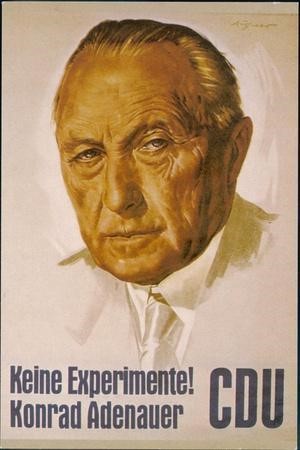
The leader of the CDU, Konrad Adenauer, instinctively smelled that SPD’s untrustworthiness had something to do with its Marxist heritage. Did not all ways of Marxism lead to Moscow, the very antipode of the civilised Western world with its refreshing breeze of Atlanticism? This suspicion was confirmed by SPD’s initial insistence on the German Sonderweg to German neutrality and reunification, and by its unwillingness to adjust to itself the position of CDU in matters of cooperation with West Germany’s Western allies.

Fortunately, in the late 1950s there was a growing awakening within the SPD that a new era had broken, that the party had to think more about its reputation within the German political class in Bonn and West-Berlin, and less about its dusty promises to the German working class. The party was ready for a much-needed facelift to make itself presentable in the new self-confident Germany of the Wirtschaftswunder.

Throwing the Marxist garbage overboard was the least painful part of the rebranding of the SPD. Marxism had ceased being an applied doctrine and living expression of the spirit of the core cadres of the SPD already in the days of Franz Mehring.  Removing Marxism from the party was hardly more dramatic or controversial than the decision to remove it from the party programme in Godesberg 1959.

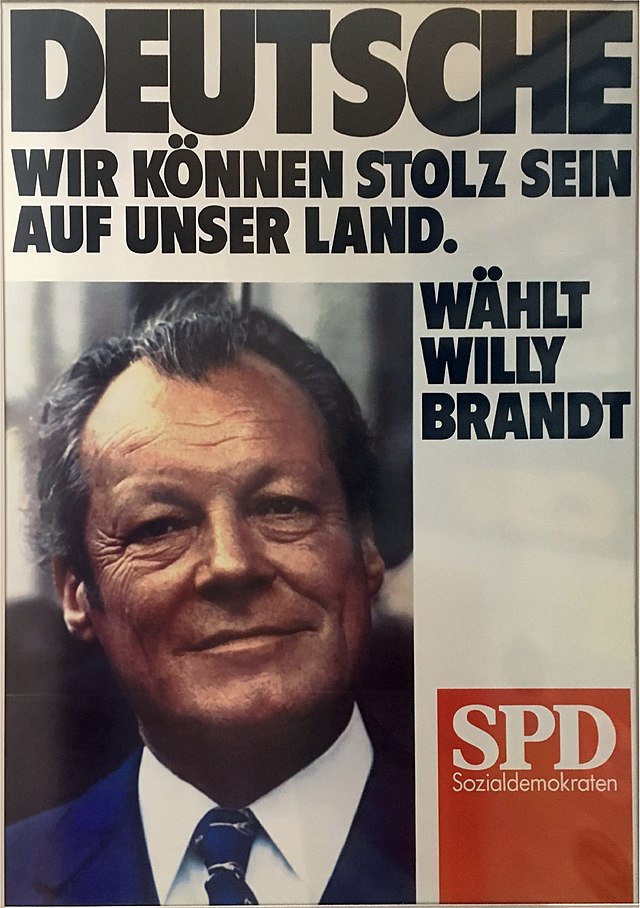
SPD’s reorientation from patriotism to Atlanticism was almost as easily settled by a formal declaration in the Bundestag the following year.[i] Making SPD a living embodiment of the Atlanticist spirit was a much more difficult problem, which would have remained irresolvable hadn’t it been for SPD’s fortune to have, within its top-ranks, a politician that made this new spirit alive in his very own person. This politician was the already world-famous Willy Brandt, the young mayor of West-Berlin.

Willy Brandt was well-known and well-received by the American public, also being a personal acquaintance of president Kennedy. More important, he had a reputation as a champion of Western values in one of the hottest trenches of the cold war: Berlin.  Questioning Brandt’s real-world merits as a cold-war-warrior was not possible without openly slandering him – a risky endeavour.

Brandt’s refulgent entrance on the political scene of Germany and the world was more than evidence enough to prove that it now was safe for any aspiring member of the West German political class to join the cadre of the SPD, without damaging the prospects of a political career.  Formally this was confirmed by SPD’s ostensive entrance into its first coalition government ever with the CDU in 1966.

Finding Brandt in the coalition government, as its foreign secretary, was almost expected.   More surprising and almost shocking was to rediscover the immortal spirit of German national unity reborn in no one other than this new foreign secretary, who recently had made himself a living testimony of the sincerity of the Atlanticist turn of the SPD. Reborn not just as an expression of the old national self-interest, but with a new awareness of Germany’s war-time guilt and a desire for absolution and reconciliation.

Harbouring warm feelings and noble desires within one’s chest is one thing; acting on them and turning them into Realpolitik is quite another thing. Brandt’s newfound ideal desire for one German nation translated to a real-world recognition of the existence of two German states and hence also the communist German Democratic Republic (DDR) together with its eastern borders to Poland.   Now it was Brandt’s turn to be questioned and given a cold shoulder not only by the CDU, but also by his former Atlanticist friends within the SPD.

However, the West Germany of Brandt was no longer the West Germany of Adenauer. In the late 1960s Germany had, once again, become a question, a question asked by West Germany’s guilt-conscious young post-war generations.  Brandt’s fortune was that his new pragmatic Ostpolitik readily presented itself as a secular answer to a question of almost theological dimensions that CDU had failed to address, in spite of its Christian pedigree.

The margin between question and answer had the effect of loosening the straightjacket of West German political discourse and blurring the line between the secular and the sacral, which suited PDF perfectly and straightened the way for the party in its role as West Germany’s kingmaker. With an accountant’s sense of the economic significance of Brandt’s Ostpolitik, the FDP and its leader Walter Scheel made it possible for Brandt to launch it as the official foreign policy of the new 1969 coalition government between SPD and FDP.

The foreign policy of the new government could almost immediately register diplomatic successes, marked and sealed by the signing of the treaties in Moscow and Warsaw 1970, in which West Germany recognised Poland’s western borders. In hard economic terms, this meant that the embargoes against West German industrial exports to the Soviet Union could be removed or relieved.[ii] For instance, West German industry could now start exporting pipelines in return for natural gas.[iii]

Unsurprisingly, these results were favourably received by the Federation of German industries (BDI) and by big corporations like Krupp, IG-Farben, GHH, Mannesmann, Siemens, BASF, etc.[iv] In fact, a liberalisation of West German trade with Eastern Europe was on its way already before the installation of the SPD-FDP government, which also was supported by the BDI.   However, none of it made the CDU any less negative in their attitude to Willy Brandt and his Ostpolitik. Pomerania, Silesia, and a large part of Brandenburg had been sold out in return for cheap economic returns.   The CDU appeared out of touch with both the public opinion and the political class of West Germany and its ruling class writ large.

Though it was argued that Brandt’s government was playing to the tune of the Soviet Union and Leonid Brezhnev, who had initiated a policy of détente after the invasion of Czechoslovakia,[v] none of its foreign policies would have been possible without the support of the US administration and indirectly also the Atlanticist interests it seemed to defy.

Already in the mid-1960s, prominent Atlanticist advisors, like Zbigniew Brzezinski, had started outlining proposals for a new cooperative policy with respect to Eastern Europe that was deemed more effective than the previous embargo policies.[vi]  In the light of these suggestions, CDU’s opposition to Brandt’s Ostpolitik made the party look more like a liability than an asset.[vii] Confrontational policies and embargoes from the time of the building of the Berlin Wall were no longer thought effective in the late 1960s, as the US grew weary of the Vietnam war and  Richard Nixon launched his détentist policies with respect to the Soviet Union and the Peoples Republic of China.

The fact that Ostpolitik easily survived the resignation of Brandt 1974, and hereafter was met with mostly nominal resistance by the CDU, was proof that the Atlanticism of the German political class had matured and was strong enough to strike a balance between Western alliance obligations and economic interests in Eastern Europe and the Soviet Union. It not only survived under the governments of Helmut Schmidt 1974-1982, but asserted itself in the midst of Jimmy Carter’s roll back of Nixon’s détentism. It even survived the hard blows delivered by the Soviet Union, as it started deploying SS-20 missiles in 1976 and invaded Afghanistan in 1979.  West German-Soviet trade deals thrived, and German pipelines kept being exported in return for Soviet gas.[viii]

Tensions between common Atlanticist interest and the particular desires of German trade and industrial capital grew, however, without evolving into an open contradiction between the goals of Atlanticism and Ostpolitik, at least not within the ranks of the political class in Bonn. Two outer factors may have contributed to this result: first Schmidt’s decision to initiate and support the deployment cruise missiles and Pershing missiles in West Germany; secondly the US decision to use the tactics of hybrid warfare against Soviet forces in Afghanistan, rather than relying on Western embargoes and economic warfare.

In the 1980s, West German trade and credits were also more frequently funnelled to East Germany rather than the Soviet Union, which deepened tensions between Moscow and East-Berlin.  The new CDU-FDP government headed by Helmut Kohl had thus remastered the Ostpolitik of SPD and showed how it could help to undermine Soviet dominance in Eastern Europe, in accordance with the overall ends of the foreign policies of the administration of Ronald Reagan.

Kohl’s Ostpolitik would never have accomplished the reunification of Germany on its own hand, without the popular protests in East Germany and Mikhail Gorbachev’s readiness to treat it as an intra-German affair.  However, Kohls Ostpolitik made it easier for West Germany to swiftly absorb East Germany and bring it into the Western sphere. Never had West German Ostpolitik been so victorious as in the moment when it seemed to serve the ends of Atlanticist policies the most.


Notes


[i] The speech was delivered by the leader of SPD in the Bundestag, Herbert Wehner, ironically a former militant communist.

[ii] Michael Kreil, ”Ostpolitik und ökonomische Interessen ”, in Egbert Jahn, Volker Rittberger, ed., Die Ostpolitik der Bundesrepublik: Triebkräfte, Wiederstände, Konsequenzen, Opladen 1974, pp. 72-75.

[iii] Angela Stent, Russia and Germany Reborn: Unification, the Soviet Collapse, and the New Europe, Princeton/New Jersey 1999, p. 22.

[iv] Kees van der Pijl, The Making of an Atlantic Ruling Class, London/New York 2012, pp. 252-253; Michael Kreil, “Ostpolitik und ökonomische Interessen”, in Egbert Jahn, Volker Rittberger, ed., Die Ostpolitik der Bundesrepublik: Triebkräfte, Wiederstände, Konsequenzen, Opladen 1974, pp. 74-75.

[v] Angela Stent, Russia and Germany Reborn: Unification, the Soviet Collapse, and the New Europe, Princeton/New Jersey 1999, pp. 19-20.

[vi] Kees van der Pijl, The Making of an Atlantic Ruling Class, London/New York 2012, p. 253.

[vii] Ibid.

[viii] Angela Stent, Russia and Germany Reborn, Unification, the Soviet Collapse, and the New Europe, Princeton/New Jersey 1999, p. 27.

Posted in Uncategorized | Leave a comment

The Russian Communists and the War in Ukraine

The war in Ukraine has divided the Western anti-imperialist and anti-fascist left. On one hand, it describes the war as an inter-imperialistic war, a war between Western imperialism and Russian imperialism over influence and hegemony in Donbass, Ukraine, and ultimately the world, a war over energy supplies and market shares, driven by falling rates of profit; on the other hand, it is described as a great war of national liberation, an anti-fascist war in the following of the Great Patriotic War.

The first interpretation is perhaps faithful to the intellectual tradition of the anti-imperialist left, but suffers from the weakness that it is more interested the yellowing pages of the orthodox Marxist-Leninist textbook than the real-world events outside the dusty book-shelves.     

The second interpretation suffers from similar defects; full of nostalgia and sentimentality it tries to prevail in the confrontation with the horrors of the meaningless war, by mastering the overwhelming feeling of powerlessness that comes from this experience. The anti-imperialist left is not defeated, no longer without alternatives, but has risen in the faith that it fights a good fight, a sacred war against fascism on the same side as the Russian Federation – the legitimate heir of the Soviet Union.      

In both accounts a special role is given to the Communist Party of the Russian Federation (CPRF) as either a traitor of the holy cause of anti-imperialism, or as a staunch and uncompromising ally of the government of the Russian Federation and its president.

Against this background it is quite interesting and refreshing to read an article on the Ukrainian war, “Class War, Imperialist, Existential”, published on the official homepage of the CPRF, which succeeds to add a new perspective on CPRF’s understanding of the war. The article also comes off as representative of the party line, considered that it is written by a fairly high-ranked party official, Denis Andreevich Parfenov, a secretary of the party organisation in Moscow. However, it must also be recognised that I don’t pretend to have any deeper knowledge of the inner debate within CPRF, and that I’ve only relied on a machine translation of Parfenov’s article.

Keeping these caveats in mind, one cannot but notice the soberness of Parfenov’s analysis. Though Parfenov describes the Russian “special military operation” as a continuation of the “liberation war” fought by the Donbass people’s republics against the “Nazi-regime” in Kiev, he also recognises the doubleness and ambiguities of the war. Thus, Parfenov carefully recognises that the war in Ukraine is an imperialist war, in agreement with the analysis presented by the anti-imperialist left-wing critics of the war, both within and outside Russia.

Even if Parfenov sometimes gives the impression that he thinks of Russia’s war as an imperialist war in the sense that it aims at control over the agricultural lands and industries in Donbass, his background discussion clearly shows that he takes it to involve something more profound, namely Russia’s influence on the entire scene of world politics. It is also against this background that the doubleness and ambiguities of the war enter into the forefront, which Parfenov thinks cannot be explained just as a product of the historical fact that Russia’s oligarchy has grafted its imperialist war on an originally popular and revolutionary war in Donbass.

Rather, Parfenov thinks that the doubleness of the war is rooted in the conflict between the interests of Russia’s capitalist oligarchy and the imperialist policies it is prepared to support. Thus, according to Parfenov, Russia’s oligarchy wants to promote its interests in Ukraine and on the world scene, but without seriously damaging its long-term role as a Western “manager” of Russia’s supplies of energy and raw materials. This also explains why Russia’s oligarchy often behaves more like a subservient comprador class than a class of self-assertive imperialists.

Short of mentioning Lenin in this context, Parfenov’s analysis of Russian imperialism strikes as similar to Lenin’s, in the sense that he tries to take into account the peculiarities of Russia’s position in the capitalist world economy and the imperialist system.  On Lenin’s analysis Russia enjoyed its peculiar status to its relative backwardness and weakness, which, in spite of its colonial possessions, largely confined it to a role as an importer of capital and a supplier of oil and raw-materials.

Parfenov’s post-soviet Russia is of course different from Tsarist Russia – among other things, it is a net creditor with a much stronger military-industrial base – but its relative economic backwardness remains, which in turn explains the despondent attitude of its oligarchy. The war in Ukraine has certainly opened up a new venue for this oligarchy, but also exposed its vulnerability as it has become subject to Western sanctions.

In the Western debate it has been suggested that Russia’s war in Ukraine cannot be described and analysed purely as an extension of a geopolitical conflict between, on one hand, the Western powers and, on the other hand, Russia, China, and the rest of the BRICS countries. Russia’s apparent strange military tactics, inefficiency, and indecisiveness has made many commentators argue that the war is a “theatrical war”. Thus, it has been argued that the war actually is a war against the peoples meant to lure them into accepting another wave of economic restructuring at their expense, this time in the name of the Ukrainian people rather than as a purportedly preventive measure against the spreading of a virus.

Parfenov does not make any references to this debate, but interestingly he shows that a parallel debate is going on within the Russian left.  Thus, among the Russian leftist critics of Putin, the war in Ukraine is sometimes referred to as the “non-war” (nevojný). Even though Parfenov is loyal to the political line of CPRF and its “critical support” (kritičeskoj  poddéržke) of the war effort, he partly gives the Russian left-wing critics right.

Thus, Parfenov notices that Russia didn’t use its full military-industrial capacity from the very start of the war, hesitated to strike at Ukraine’s energy infrastructure, at least not before the Ukrainian strike at the Crimean bridge, etc.   He also notes the shortcomings of the present military mobilisation in Russia, and how the authorities have used the war as an excuse to clamp down on opposition and to generally continue the limitation of the civic rights of the Russian people, which started already with the anti-covid measures of the Russian authorities.

However, according to Parfenov the deficiencies of the Russian war effort is not an expression of some collusion or even conspiracy between Russia and the Western powers. Rather, it is the result of a peculiarly home-brewed dysfunctionality of the Russian state, rooted in the interests of the compradoresque and submissive Russian oligarchy. Indirectly, what Parfenov suggests is that the Russian military cannot solve its tasks unless it is given the resources it needs, which depends on a “deliberalisation” of the Russian economy at the expense of the short-term interests of the Russian oligarchy.

In many ways the recent weeks (December 2022) have illustrated that Putin and the Russian government are prepared to do what it takes to strengthen the Russian military-industrial complex and the Russian state’s ability to plan the economy. But Parfenov warns that it is a delusion to think that the Russian state now is decoupling from the interests of the oligarchy. Instead, the Russian political class increasingly finds itself squeezed between its war-time military duties and the pacifying sentiments of the Russian oligarchy, which just wants to get along with the West and preserve the “liberal”, post-Soviet social order in Russia.

In sum, Parfenov’s article presents his readers with an interesting glimpse into the internal debate within the CPRF and the broader circles of the Russian left. In our dangerous and complex times such insights are definitely needed as a counter-weight to the Western leftists and their oversimplified and distorted picture of the Russian communists and their analysis of the war and its effects on the political situation within Russia.

Perhaps even more important, without a better knowledge of the Russian debate we in the West are doomed to make the mistake of reducing the Ukrainian war to a conflict between Russia and the West, which means that we will continue to ignore that this war also involves a conflict between the great power interest of the Russian state and the interests of its Western oriented and profit-hungry oligarchy. In any case, it is within this actual field of conflicts that the Russian communists and patriotic left must live and operate, if they want to correct their mistakes and regain the trust of the masses…   

Posted in Uncategorized | Leave a comment

The Ukrainian War and the Fortunes of the Unplayable Atlanticist Script     

We who live in the 2020s certainly live in curious times: exciting and eventful, and yet excruciatingly boring and empty.  The Western liberal political class of the present ancièn regime acts out in ever more colourful ways in an illusory spectacle that just looks increasingly forced and repetitive to the theatre audience. To be frank and honest, at this time not a few of us just want the entire charade to end so that we can go home and continue our ordinary lives. Some unpolite members of the audience have even started boing at the actors, and yet nothing happens. It just goes on and on, scene after scene. The star actors may be replaced by lesser and more dull talents, but the show goes on.

Now, it is not surprising that a political class or elite clings to its power and position in society, particularly not one that owes its prestige and legitimacy from the same origin as the Western democracy, in which it was born and which it has heralded since over a century. Furthermore, unlike its aristocratic predecessors, the power claims of the Western political elites rest not only on outer democratic legitimacy, but also on its preference for meritocracy and the impeccable virtues it fosters.  One may of course argue that these claims are false, for never in history has a political class risen to power by mere elections and never has pure merit been left untouched by the nepotistic practices of political dynasties. However, these arguments carry no more weight than the objection that theatre actors never are the role characters they are playing. What matters is the ability of Western politicians to act so to keep the democratic political spectacle going.


For generations Western politicians have shown that they are capable of acting convincingly, even in situations of wars and economic crises. In their own eyes this is largely the result of their merits as theatrical performers, but in fact it mostly depends on the qualities of the script that has been handed over to them by their political playwrights and casting directors, people like advisors, media-people, spin-doctors, etc. To the fortunes of any such political script belong that it must allow Western politicians to go to war only to defend democracy. Western wars are fought in the name of democracy, against tyrants, authoritarians, Nazis, communists, Islamists, etc. This is not only a way of preserving the democratic legitimacy of Western political elites, but also a means to keep them united over the Atlantic.

America can of course go to war for any purely “patriotic” reasons, as long as they serve its imperial interests. However, to be perceived as justified in the eyes of Western European allies and their electorates, US wars have to be presented in less parochial and more universalist terms. It is this which gives the Western political script its typical Atlanticist bent. Western Europeans are meant to like, or at least accept, US wars even if they have more to gain from staying neutral or even oppose them. The Atlanticist script is meant to filter out the patriotic dialect of the US wars, so that Western Europeans can read into them what they like to read: a story about a war that is (a) easy to win, (b) fought against an enemy of democracy and human rights, and (c) necessary to restore or preserve peace.

Rewriting US imperial wars looks like a thankless task. Western Europeans joined the war in Afghanistan (2001-2021), but soon found out that it was not easy to win. They were never convinced that the Iraq war (2003-2011) was needed to preserve peace, and they soon found it difficult to perceive Viet Cong as the enemy of democracy and human rights during the Vietnam war (1955-1975).  The war in Libya (2011), which only needed slight re-editing to fit the dramaturgical requirements of a successful Atlanticist script, is an exception. US imperial wars are just, so it seems, impossible to stage on the Western political scene, at least not without tearing apart the sacred Atlanticist manuscript.

Yet, we know that Atlanticism was able to survive both the Vietnam war and the Iraq war, perhaps not untainted but still. Not just Atlanticism as a specifically military and political institution, built on a mutual stream of foreign investments, but as a shared sentiment of belonging to the same Western community of democracies. Surprisingly, America has been able to live through the ageing life cycle of its inevitable imperial wars without losing its credentials as star actor on the Western cultural and political scene. On the contrary, both the theatre ensemble and its audience have been steadily growing as a result of the expansion of EU after the downfall of the Berlin wall.

The Atlanticist script has always been able to give leading US politicians a sense of stardom, even when they fight wars that Western Europeans dislike. The key behind the successes of the Atlantic playwrights is their flexibility. Skilled in their trade, they know the art of reframing and darkening the character of their Western heroes. US presidents, which fight imperial wars that look inconvenient or unjust in the eyes of Western Europeans, can always be reframed. Their character is either darker than we first thought, or become darker as the wars unfold. These roles are typically scripted or casted for republican presidents, like Nixon, though occasionally also democratic presidents, like Kennedy, appear in these roles.

Scripting republican presidents for the roles as dark heroes and commanders of “ugly” imperial wars is more an issue of production economy than dramaturgy. Imperial wars that are costly and difficult to win take a lot of effort in terms of preparatory planning and logistics. Their success depends not only on decisions made by politicians and military people in Washington and Pentagon, but on investments by people in the oil, steel and weapons manufacturing industries. These latter people belong to a separate class of tycoon-like capitalists that Carl Oglesby once titled as “Cowboys”. As Cowboys they like republican presidents that are insiders to the oil and weapon industries, which explains why republican presidents more often than not are typecasted as the dark commanders of outdrawn imperial wars.

Nevertheless, none of this makes Democrats and progressives any less important in the Atlanticist script. On the contrary, Democrat Congressmen and progressive activists play a major supporting role in the US imperial war drama. The progressive or leftist students that protested against the Vietnam war and the Democrat Congressmen that voted nay to the Iraq war all contributed to Western European sentiment that “their” America would come back, that these wars were inconsistent with the democratic and humanitarian core values of the empire. On a purely ideal level of images, hopes, and desires, US liberals and progressives have, consciously or unconsciously, made it possible for Atlanticism to survive even under the pressure of such blows as the Vietnam war and the Iraq war.  In their indispensable role as supporting actors, war opponents make it possible to put breaks on US imperial war efforts that may harm the interests of those East Coast “Yankee” interests in the high-tech and financial industry that rely on an unscattered Atlanticist relationship with Western Europe.

Superficially the present war in Ukraine (2022- ) looks like the perfect Atlanticist war, a righteous proxy war in which America and its NATO-allies fight against an authoritarian aggressor, namely Russia. The leading war hero of this Atlanticist drama – Volodymyr Zelensky – is even a professional actor. With their impressive display of indignation and moral fervour, it is also easy to cast Western politicians in their roles as supporting heroes.  The trouble is that we expect more than verbal bravado from the supporting heroes. We expect that they are able to project physical strength in situations when the leading heroes are outnumbered by their evil enemies and simply cannot win in spite of their superior moral virtues. Without that strength the supporting heroes are no more than despicable weaklings destined to betray the leading heroes in their darkest hour.

The Western leaders’ clumsy and ill-prepared way of handling themselves in the Ukrainian war has certainly made it increasingly difficult to direct the war in according with the Atlanticist manuscript.  What should have been the perfect Atlanticist war has become a nightmare, a ticking bomb of stagflation and irrevocable public discontent, ready to explode at any time in the hands of the Western political class.

Preserving the legacy of Atlanticism at this stage thus demands that the Ukrainian war is reframed as a dark war, a war that America perhaps needs to fight but internally revolts against since it contradicts its cultural identity as a Western country. On the dramaturgical premisses of the Atlanticist script, this means that the US president must be recast as a dark hero against which Americas liberals and progressives protest together with the war weary Western Europeans. However, with Joe Biden in the office as president this scenario is simply impossible. Biden has already been cast in the Lincoln-like role as the ultimate hero that stands between the US constitution and the MAGA-hordes of racist insurrectionists. No liberals or progressives will ever rally against a president of that stature, at least not just because of his performance as a war president.

As a result of the twisted dialectical logic of the war, the Atlanticist playwrights thus find themselves at a crossroads: they must either leave the Ukrainian war script as of February 2022, and save themselves from having to contest the beliefs of the angry crowds of anti-Trumpist liberals and progressives, or rewrite it in tune with the sentiments of the Western Europeans.  Regardless, there will be large masses of voters and political activists, on either side of the Atlantic, which want to disassociate themselves from Atlanticism and the political class that defends it. The Atlanticist political class and its playwrights will increasingly become aware that they are damned if the do and damned if they don’t – hardly an enviable position.

Unless the Western political class wants to get stuck in a situation where they cannot rule any longer – a situation eerily similar to a revolutionary situation – they will have to push for a change.  Only time can tell, but as things look right now, they will sacrifice Zelensky and his regime in Kiev. Far from being a conventional recasting of the Atlanticist war script, it will look less like a dark tragedy and more like a horror story, a story of humiliation, fear, and endless unfathomable anguish. A story that might save Atlanticism for the time being – however only at the expense of Western dignity and international influence.


Posted in Uncategorized | Leave a comment

       Reflections on the Coming Catastrophe

                                                                             I

The principle of the contemporary West: the loss of its previous spiritual depth and maturity, manifested in the endless desire to transcend of all boundaries and limits of human life (Spengler).  Specifically expressed in the crusade, i.e., in the search of an outwardly manifestation or form in which it can recognise and subjectively affirm the truth of its impoverished and immature spirituality (Hegel).

                                                                        II

Within the borders of the West the crusade begins as an act of self-cleansing, as an attack on its inner enemies which are carefully sorted out. Without the inner purge the crusade attains no reach outside itself as an act of conquest. In the contemporary West of today this inner purge is visible in the ostracization of any opponents to the prevailing corona-narrative and the covid-restrictions, and in the condemnation of them as enemies of the state and ultimately the entire humankind. In short time open sadism and hatred towards ordinary citizens with a different opinion about what should happen to their bodies have suddenly become fully acceptable attitudes in public discourse and debate.

                                                                      III

The peculiarities of both the inward purge and the outward crusade will inevitably bear the marks of the political class that holds the seats of state power in the contemporary West. This is not a class of statesmen and generals. Rather they are a class sprung from the managerial class. Thus, they are typically university/college educated people with no professional experience other than as officials or spokespersons in the global corporate sector, the NGO sector, or the trade-union sector. The Dutch politicians in the Tweede Kamer are a perfect example of this stock of people. They are not policy makers, but policy enablers. They are trend-sensitive, virtue-signalling people good at adapting themselves to the desires and whims of the ruling classes, but indifferent to their consequences for ordinary people. The coming storm will sweep them away, unless they adopt to the new realities.   

                                                                    IV

The covid-crisis was the inward purge of this class.  In purely economic terms the covid-crisis was really nothing but a good old capitalist accumulation crisis, covered in the illusory appearance of a biological-pandemic crisis. Politically it was about reassuring the authority of the liberal states, the authority and right to “cancel” their enemies.  The covid-crisis involved a large interruption in the accumulation of capital, massively inflicting on the service and leisure sector: hotels, restaurants, cafés, etc. On the one hand, it reduced the expenditures of non-productive labour and its reallocation to the state sector in the form of debt (=Biden-economics); on the other hand, it contributed to the redistribution of incomes and wealth. This time they direct their energies not against non-productive labour, but against the pillar of the production chain, against raw-materials, intermediary goods, etc. Yesterday: because infectious. Today: because Russian.

                                                                        V

The Principle of the East: the principle of inward spiritual contemplation and groanings. The principle of Russia.   It is the spirit that defines itself in opposition to the West; the spirit which admires the West, but in the end affirms its historical roots in Orthodox Christianity and absolute despotism. Outwardly it manifests itself in the loyalty to the Russian Empire and geographic boundaries. Ruthlessness towards its historical enemies; contempt for the inferior peoples it supresses.

                                                                       VI

Putinism is the contemporary expression of the Principle of the East – the final replacement of marxism-leninism as the ruling ideology of the new, post-soviet Russia. Putinism immediately transforms itself and establishes itself as “War-Putinism”. Making a state of emergency normal to Russians, even in the absence of a pandemic threat.  

                                                                      VII

Russia is already in war with the West – it has now developed from a cold war to a hot war. Not directly, but indirectly as a proxy war. Ukraine is the Spain of Western pandocratic, authoritarian liberalism. Though Westerners might think of it as a war between two states it is originally a гражданская война, a civil war. The result of a generation of stupid and spoilt Western politicians completely lacking any sense of the seriousness of war. War for them is a game in the virtual reality of the spectacle – it is tweets by military means. They are virtual revolutionaries without a sense of realpolitik and the need of power balances and political equilibria.   Temporarily the Ukrainian war curbs the reshoring of industrial capital from Asia to the Western world. Making fossil fuels more expensive, it accelerates the transition to the fossil-free, renewable energy capitalism of the Biden-administration. This accords with the interests of the ruling Anglo-American capitalist circles (“Yankees”); they fought Trump and his Neo-Mercantilist reindustrialisation programme for a very good reason from their perspective. 

                                                                        VIII

Ukraine is a country within the historical Russia that consciously rejects the Eastern principle in order to become westernised. It is the conscious effort to severe Slavic identity from the Eastern principle. To remain a Slavic people in outwardly form, but with a completely westernised principle. Ukraine is a Latin text written in Cyrillic syllables. It defines its autonomy in opposition to Russia, while completely succumbing to and accepting its status as a tool of the West.

                                                                        IX

To the Germans of the Second and Third Reich Ukraine was a potential colony, a vast agricultural land for the settlements of their farmers.  To transatlantic Anglo-American imperialism it is mainly a mechanical machine, a wedge between Europe and Russia, a way of severing Berlin from Moscow, a way of preventing the possibility of an upcoming, autonomous Euro-Asian power block.

                                                                        X

Germany is now rapidly transforming itself into a kind of semi-independent Fourth Reich on war-footing, most likely for an unforeseeable future. This new Germany can think whatever it wants about Russia, but the historical truth is that it will be affected by Russia. Each sanction, each weapon delivered to Ukraine will sooner or later turn back on Germany itself.  Germany is now forging the weapons of the coming civil unrest that will ravage it and the rest of the European continent. Another name for “civil unrest” is class-struggle transmuting itself into class-war.

                                                                         XI

In Russia the covid-narrative is quickly dismantled, devolving itself to that which it was meant to be: a preparation and rehearsal for a state of emergency.  Finally, Russia has found its way back to tsarist, imperial despotism with which the Russian state always has reassured its existence. Despotism is for the Russians, autocracy is for the Germans and Austrians.  Behind the corona mask is the mask of post-liberalism: despotic in Russia, authoritarian in Germany-Austria.

                                                                           XII

Russia just cannot retreat or back down. This is an existential fight for recognition. They won the war against Germany, but they lost the peace. They offered a neutral, unified Germany, but were turned down. (Yes, the Stalin-note of 1952 is questionable but it fits into Beria’s 1953 plans for Germany.) Gorbachev gave up the entire Germany without getting anything back except money and food shipments. That’s how you treat a fool, a nobody, a shabby servant.  Clearly the invasion of Ukraine has made it clear that Russia does not want this to happen one more time; it will not accept the experience of German reunification repeated all over again, but now in the heart-land of the historical Russian empire, on the steps of its virgin daughter Odessa, on the shores of the Black Sea, in the light from its jewel, the Crimea.

                                                                        XIII

On the surface Ukraine displays all the phenomena we recognised from the post-modern spectacle: everything in its official narrative is inverted, ahistorical, topsy-turvy and utterly fake. History exists only as a myth. But on the other hand, it has not learnt how to play the game of liberal parliamentarism. The capitalist oligarchs rule themselves, which allows them to immediately plunder the state without the time-consuming mediation of costly spin-doctors and lobbyists.  Their lack of appreciation of the finesses of the art of western parliamentarism is immediately visible in the open brutality and thugishness with which they let their parliamentarians be treated.  

                                                                        XIV

Zelensky: the personification and singularity of the global spectacle, the space of all inverted and illusory phenomena of commodity exchange and capital. His dialectical mind, his vivified dialectical effort to isolate every contradiction between the spectacle and the actual world is absolutely fascinating. He is not avoiding conflicts like a medium sized dog, no he consciously sniffs them up like the little dog he is.  Within his persona, with his face, his personal voice and appearance he combines the hysteria, the bitching and moaning of the entire Western world of all progressive liberal cat ladies, political pundits, greasy neo-cons, journalists, managers, and parasitic politicians. Successfully they cancelled and locked down the Brexit-movement, the Trump-movement, all white men, all small shop keepers and business owners, all anti-vaxxers, and finally also all truck-drivers and blue-collar workers. Now, they have finally entered the end and truth of their fascinating journey towards complete cancellation of everything that contradicts their self-contradictory and self-righteous narrative: Russia. Lock down Russia! Install a no-fly-zone over it! Yes please, do that!

                                                                        XV

The Tragedy of Ukraine: the mixture of Ukrainian independency movement with German imperial ambitions, which transformed itself into Ukrainian chauvinism and finally the collaborationism of Ukrainian fascists.  Finland instrumentalised the Germans, militarily and technically, but without becoming moulded by their imperialism and chauvinism. 

                                                                        XVI                                                         

Foreign mercenaries in Ukraine: they are the civil-war counterpart to the lumpenproletariat on the streets in the protests on the streets of the Western cities. Russia does not need these foreign mercenaries: it has its Chechens. Russia is, after all, an empire.

                                                                            XVII

The seriousness of the situation cannot be underestimated: it is highly likely that Ukraine is transformed into a new Syria or Afghanistan, but this time a European Afghanistan. Not only a hot-spot of terrorism, but a recruitment base of terrorism. The possibility of engaging Muslims from the West in a religious war against the Christian Russia are, so it seems, boundless.

                                                                           XVIII

Western Europe is already largely Islamised in the suburbia of its big cities. France is northernmost part of Mediterranean North-Africa.  Energising this population against Russia might look tempting, as tempting as luring the Turks into the fire, but it also serves as an operational base for an upcoming civil-war in the West. The civil war in the East will not rest but move to the West. 

                                                                          XIX

Isolating Russia and engaging in economic warfare will inevitably lead to increasing prices on energy and food in the West. It will amplify the redistribution of incomes and capital, but also the capitalist crises that already was visible during the corona pandemic.   We are already living in a time of civil protests, approaching civil unrest as a permanent state and perhaps also a civil war in Western Europe. No serious popular movement wants a civil war. It wants to avoid it. But if a civil war comes, we already know how the ruling classes will respond: by declaring the Western European countries in a state of emergency.

                                                                            XX

The riot in Rotterdam (“de rellen in Rotterdam”) on Friday evening 19 November 2021 gives a show case of how such a state of emergency might be put in place. In fact, the Dutch government had already prepared the ground for a state of emergency by declaring a partial lockdown and the coming introduction of covid passports in the Netherlands.

Posted in Uncategorized | Leave a comment

Bonapartistiska reflektioner

Blad IV. Sverige: 2001–2015

I ruinerna av EU-motståndarnas nederlag 1994 stiger en ny opposition av altermondialister och anti-mondialister. Visserligen lider man ett nederlag under Göteborgskravallerna 2001, men i omröstningen om euron 2003 är man mer framgångsrik. I Junililistan samlas de försiktigt oppositionellt lagda journalisterna, akademikerna och professorerna (Wibe).

I maktalliansen har socialdemokratin visat sig användbar, men nu börjar den allt mer och mer uppträda som en belastning. Inte bara för att man misslyckades med att upprepa konststycket från folkomröstningen 1994, då man fick med sig fackföreningsrörelsen för ett EU-inträde, utan för att man återigen har problem att återskapa sitt band till arbetarklassen. Visserligen har arbetslösheten minskat, som andel av arbetskraften, men den befinner sig fortfarande på hög nivå, vilket på sitt sätt är själva meningen med den nya maktallians som etablerats.

Göran Persson är hämtad ur socialdemokratins kader av kommunalråd och tjänat sitt syfte väl. För att han genomför kommunaliseringen, som slutligen berövar gymnasielärarna på all glans från de borgerliga läroverken, och för att han genomdriver Lindbeckkommissionens program….. Men det räcker inte: Göran Persson låter sig inte förvandlas till en Gerhard Schröder eller Tony Blair. Han varken kan eller vill förvandla socialdemokraterna till ett svenskt New Labour.

Den rollen går i stället till moderaterna, till Gösta Bohmans sentida och betydligt kyligare arvtagare Fredrik Reinfeldt. Lustigt nog väljer han namnet ”alliansen” på den borgerliga partikonstellation han leder – som om han nu ville göra ensamt anspråk på att företräda den stora alliansen, det maktblock som gett sig uppgiften att genomföra systemskiftet.  Från den gamla socialdemokratiska välfärdsstaten till en stat bättre tillskuren för ett nygammalt, mera parasitärt finanskapital.  

Reinfeldt appellerar till missnöjet över arbetslöshet, över parasitism, över för höga skatter. Skuggbefolkningen skall in i arbetskraften och in i industrin, och folk som arbetar skall få lägre skatt.  

Det ger ljuvlig återklang i den svenska befolkningens djupschakt. Om du arbetar hårt och tjänar bra på att svetsa långtradarchassin, men till priset av söndervärkta händer, varför skall du då inte få behålla mer av din lön?

Men kapitalismen slutar inte producera överskottsbefolkningar: arbetslösheten växer under den djupa kapitalistiska kris som inleds 2007, allt medan skuggbefolkningen fylls på av invandrare och utslagna. 

Mot regeringen formerar sig en slags enad röd-grön opposition, bestående av tre sinsemellan repellerande element: socialdemokratin, miljöpartiet och vänsterpartiet.  Man utger sig för att vara en röst åt arbetarklassen, men folkflertalet sniffar sig till att man är något annat. En röst för en fraktion inom den politiska klassen, som tar stöd i reservbefolkningens brokiga massa av bidragsberoende, migranter och trasproletariat.

Utan att bry sig nämnvärt om vare sig fransk historia eller Louis Bonaparte har man anat sig till att de röd-gröna är en sentida efterföljare till 10-decemberföreningen.  Man har inte en Louis Bonaparte som general, men en rövardrottning av ädlaste börd ur den politiska klassen: Mona Sahlin.   

Vid sidan av denna inomparlamentariska fraktion står ett annat parti, som fångar missnöjets tidsanda bättre: Sverigedemokraterna. Junilistans professorer tynar bort i en knappt hörbar sista suck. 

Rätt snart vinns en betydande seger: Sverigedemokraterna träder in i Riksdagen, 2010.  Kyrkklockorna ringer, predikstolarna dundrar, ledarsidorna glöder av vrede.  Sverigedemokrater misshandlas, smutskastas, avskedas och knivas. Dock utan synbar verkan på opinionsläget.

I bakgrunden växer den, skaran av de miserabla, de utnötta och utstötta. De trötta vårdbiträdena, de söndertjatade lärarna. De desillusionerade och förnedrade prästerna. Officerarna utan regementen och förband. Industriarbetaren som antingen blivit arbetslös eller förvandlats till egenanställd hantverkare.

Som hantverkare hoppas han kunna vidga sin verksamhet, anställa, starta en sidoverksamhet, kanske en biltvätt en verkstad i en angränsande bruksort och därmed bli en del av småborgerligheten. Den småborgerlighet som i bruksorten eller landsbygden ofta utgörs av en kurdisk frisör med ett par tre anställda, en turkisk pizzeria eller en liten svensk tobakshandel med ATG-spel. 

Utsikten att bli något mer än en egenanställd företagare är små, fast det behöver inte vara dåligt för han klarar sig och ibland riktigt bra. Men hans band till tidigare yrkesbröder, ja själva sin klass, är upplöst. Ibland kan han få ett jobb som entreprenör vid ett vägbygge och får då tillfälliga kollegor som han slänger käft med eller tar ett bloss med. Men något djupare än så blir det inte. Han saknar organisatorisk hemhörighet och befinner sig som sådan i politiskt underläge, varken han tänker på det eller ej.

I den traditionella industriarbetarklassens ställe tillförs arbetarklassen nya medlemmar i vård, omsorg och handel. I de företag och organisationer man arbetar är verksamheterna ofta reducerade, slimmade, privatiserade. Genomträngda och underställda ett finanskapital som suktar efter nya vägar att extrahera skattemedel. Kollektivisering och underordning präglar detta skikt inom arbetarklassen. 

Man är ömsom föremål för diverse personalinsatser, friskvård, individuella utvecklingsprogram. Men inget av detta leder till ökat inflytande över arbetsplatsen, i förhållande till organisationens verksamhetschefer. Lönen förhandlas individuellt, ofta i underläge. Man gör klokt i att hålla tyst om missförhållanden på arbetsplatsen. Man är visserligen inte så individualistisk som hantverkaren, men någon ork eller vilja att försöka förstå de större sammanhangen finns ej. Man släpar sig fram som i ett töcken under arbetsveckorna. 

Töcknet är dock flyktigt och skingras allt oftare av den känslomässiga vissheten och ilskan att man blivit lurad, snuvad vid näsan. Först kanske på villan eller anställningen, sedan pensionen och till sist också nationen.

En ny sorts press som finns på nätet – de så kallade ”hatsidorna” – ger ett  uttryck för denna ilska. Helst vill man från de svenska myndigheterna stänga ner denna press, jaga den under jorden såsom i Frankrike våren 1850. Problemet är bara att den redan är under jorden eller snarare ovan den i den idealt digitala sfär dit valutahandeln och börsen redan migrerat.   

Efter valnederlaget 2014 erbjuder sig Reinfeld att försvinna från statsministerposten.  Vänsterpartiet har redan lösgjort sig från de röd-gröna, som nu kan fogas samman med alliansen till en ny representant för maktblocket som får heta decemberöverenskommelsen. I dess ledning petar man försiktigt fram den lågmälde Löven, en slags svensk proletär variant av Louis Phillip. Borta är sedan länge Rövardrottningen.     

Så tycks Sverige röra sig i baklänges riktning: bort från Bonaparte och närmare Orleans. Men det skall visa sig falskt och redan hösten 2015 får Löven, med bröstet fullt av lidelse, visa att hans hjärta är lika varmt och lika öppet för reservarmén av migranter som någonsin Rövardrottningens.  På medborgarplatsen ropar han: ”Mitt Europa bygger inga murar!” Ett rop som oppositionen genast tyder som: ”Mitt riksdagshus reser inga murar mot reservarmén!”

Klämd mellan decemberallians och reservarmé skall oppositionens och folkets moraliska motstånd brytas en gång för alla.   Som en stormflod störtar reservarmén in i landet, in i kommunhus, länsresidens, in i slott och herresäten, skolor och domkyrkor – och till sist också in i själva riksdagshuset. Där rycker den med sig decemberalliansen som bryter samman. Regeringen överlever visserligen, men regeringsmakten är svagare än någonsin.  

Posted in Uncategorized | 1 Comment

Observations on the Fourth Industrial Revolution


                                                                      I.

The present-day situation shows more than anything else the conflict between the ruling classes and the peoples. On one hand the power-block between financial oligarchy, the bio-digital-robotic capitalists, and the managerial class, and on the other hand the working class, the petty bourgeoisie and the lower professional strata of the managerial class.  To the latter classes it has become more and more apparent that the present-day capitalism is incompatible with the rights to rest and leisure, education and work. Commodifying everything that belongs to the necessities of human life, it makes it an arena of profit, power, and control.  

                                                                   II.

In the wake of the financial crisis of 2007 a new bio-digital-robotic industrial capital has made itself ready to enter the scene. Enter the scene of politics, full of promises of an era in which data computing and digitalisation is combined with robotisation, artificial intelligence, and low-cost genetic engineering.  Bolstered by financial capital and debt it looks for an economic and political regime ready to promote its interests and adjust the institutions to its desires. In short, a regime ready to adjust itself and open up the markets to an entirely new supply of goods and services emanating from the well-springs of the fourth industrial revolution.  

                                                                   III.

The new technologies of the fourth industrial revolution open the prospects of future reductions of the work time, increases in social investments, and welfare improvements. However, the thrust of the agenda of the fourth industrial revolution is to increase the rate of profit and promote the control-functions of the new production processes. On the political level the transition to this new accumulation regime is nothing but a revolution from above, which at the present stage takes the form of an authoritarian semi-dictatorial pandocracy.  

                                                                  IV.

The control aspect is of course not new: capitalist technologies of production are always designed to function as technologies of control, surveillance, and documentation of the production process. What is novel about the fourth industrial revolution is that it offers technologies capable of controlling the consumption process as well, in particular the consumption of services. From now on consumption will be managed and engineered on its most fundamental level, the level of preferences and choices.  Consumers that make “rational” choices in accordance with “sustainable”, “safe”, and “risk-averse” preferences will be rewarded. Budgets of individuals and households will be ironed out and directed to promote sustainable and safe consumer patterns.  Moreover, not only budgets but also corporate and state directives may constrain the consumers’ access to goods and services.

                                                                 V.

Ideologically constrained consumer goods and services will be branded as “luxury consumption”.  Such luxury items may not only include private diesel fuelled motor cars and groceries like meat, but also visits to restaurants, pubs, and hotels. The latter means that large parts of the petty bourgeoisie will be wept out and destroyed. The ongoing digitalisation of the retail industry and certain parts of the service industry intensifies.  

                                                                VI.

Micromanaging the level and structure of the old demand thus goes hand in hand with an effort to stimulate consumer demand for everything that the new bio-digital-robotic capital is ready to supply them with, including everything from gene-therapies to electric cars. Creating a world in which the share of wages can be lowered, without having to reduce the level of consumption and consumer credits –Alas! That is the traditional Achilles heel of capitalism, which the fourth industrial revolution now promises to remove forever. 

                                                              VII.

In the long run, the fourth industrial revolution even sets its gaze on the very biology and psychology of human needs, desires, and emotions, with the ambition to make them more risk-averse and more malleable to the directions of the corporations and the state. The perfect consumer will not be shaped by propaganda, but rather edited by gene-therapy. No longer a mere producer of the product she consumes, the consumer becomes a supplier of the biological raw-material of this product.  

                                                              VIII.

The fourth industrial revolution sounds the death-knell of Western mass consumption as we have known it to this day, as a real mass phenomenon and spectacle.  The deeper-seated consequences of these transformations are enormous: they mean that the reality of the masses (Ortega y Gasset) comes to an end. Masses in the relevant socio-political sense will no longer exist in physical space, only in the ideal and digital space of the internet. The downfall of the West, what is it other than the downfall of liberal-libertarian mass-consumerism (Clouscard) and its replacement by a new capitalism of control and austerity?

                                                               IX.

In the digital space the state will unfold its main directive: to keep the masses separated and individualised in their being as life-less compounds of passive atoms, at a safe distance from the state and the power of the political class and the ruling classes it serves.  No populist movements will ever see the light of the day again. Their leader – the populist political buffoon – has been safely absorbed and neutralised within the ranks of the political class and its spectacle. In his place enters the narrow-minded control-freakish elementary-school headmaster, which surveys that everyone follows the latest, daily or hourly state-sanctioned orders of the corporations of the bio-digital-robotic capital.

                                                               X.

Part and parcel of the elimination of the masses is the inevitable de-personification of the political representative in favour of the manager. Though managers may be replaced by robots and surveillance software, the events of the last two years (2020-2021) show how strongly they stick to the hope that they will be needed in their capacity as controllers, directors – and ultimately snitchers. The more successful they are, the more hated they will become.   

                                                                XI.

On the other hand, it must be carefully observed that the destruction of mass consumption marks the beginning of the end of commodity production as we have known it. In a world of 3D-printers the boundaries between the production of commodities and the production of services will be blurred. The opportunity and necessity of new, seemingly utopian forms of human production and exchange within mutual-aid societies of like-minded will not only be possible, but necessary. These societies will live side by side with the capitalist corporations, which will be ready to sell their production plants to the societies at scrap-prices once they stop being profitable. Life-less and fully automatised by robots these production plants only require miniscule inputs of living labour.  Labour that will be supplied by these societies in cooperation with the state. Though this opportunity may seem utopian today, it appears so only from our narrow-minded present day point of view.

                                                               XII.

The last two years have seen an unprecedented growth in the quantity, quality, and depth of the awareness of the masses of the totalitarian tendencies of the state – which for has been covered by the increasingly lifeless and formal procedures of parliamentary debates and elections.  People have learnt more the last two years about the real enemies of freedom, welfare, and human dignity than the last twenty to thirty years.

                                                               XIII.

The weapons of the powers to be have all been laid down in the open, to be seen by the masses, by the people. It has become apparent that the mere critique of power is branded as “extreme”, as “right-wing”, as “hateful”, etc.  Charges against opponents of EU or migration, etc, are now directed against protesters of vaccine-passports, the use of QR-codes, etc. Dissidents are no longer persons questioning broadly accepted ideologies, policies or bills, but people who defend what previously was thought as the natural right to follow their own personal routines and inclinations. Rule following has become hellish, a matter of fluctuations, no less erratic and volatile than the short-term movements on the currency market. 

                                                                 XIV.

The new bio-digital-robotic capital of the fourth industrial revolution – personified by people like Musk, Bezos, Gates – has been made visible to people. “Capitalism” is no longer part of some abstract, dead terminology from the 19th century or from the communist movement, but starts to make sense as a term denoting something highly real. Capital and capitalist oligarchs are, briefly stated, present everywhere.  More often than not, they show themselves immediately, unfiltered by media and independently of the hapless representatives of the governments. This is a fact, and it cannot be denied.

                                                                  XV.

The possibility of resistance cannot be constructed by any one-sided political or ideological movement, but has to be given as real and spontaneous. This is exactly what has been happening the last year – the year 2021. Exploring this possibility gives a taste of real power or at least an idea of what it means to resist the real power of the state, as an apparatus of the ruling classes. Though we are far from seeing any visible signs of victories and though the protests have been defensive and reactive rather than offensive than proactive – they are important for the time to come.                                                        

                                                                  XVI.

Real victories will have to offer real-world solutions to digital problems, and digital-ideal solutions to real-world problems. Victories that offer new opportunities of life, in communities of mutual work and assistance, opportunities beyond the old abstract pseudo-reality of the old masses. Though these communities might sound utopian and anarchistic, they will become a socially necessary possibility in the course of time.

                                                        XVII.

 Unlike the stupid and backward conservative, populist and nationalist movements, the national and international representatives of the bio-digital-robotic capital have shown themselves vigilant, proactive, provocative, revolutionary. Their weakness is that their clever revolution moves at a pace even faster than their relatively unprecise gene therapies.

                                                      XVIII.

In the long run no victories will be won unless they are offensive and proactive. There is no reason to think that the power-block of the financial oligarchy, the bio-digital capitalists and the managerial class will let go of their power without a fight.  In this struggle the atomised, digitalised masses will inevitably lose unless they receive help from strata of the professional class – technicians, coders, biologists, geneticists, medical professionals, etc. – that have an interest in adjusting their techniques to the socio-biological nature of man, rather than the other way around.

                                                       XIX.

One of the weakest spots of the new bio-digital-robotic-capital, in its search for a new political regime that adequate and receptive to its interests, is its spontaneous ineptness and blindness to the needs of the state.  Not the needs of the nation or even the nation state, but the needs of the state as such. Already the neo-liberal accumulation regime was inherently hostile to the nation state and sought to dissolve it by free-market agreements, national deregulations, supra-national political bodies, currency-unions, end-less chain-migration, etc. However, the pandocracy shows itself disinterested in or even hostile to the very existential conditions of the state: a geographically defined body of power that eradicates the tribes and creates a people in its own image – a politically unified population within the determinate boundaries of a definite geographic location. The pandocracy of the bio-digital-robotic capital knows no geographic boundaries, only malleable domains and subdomains in the world-wide-web of its power.  

                                                               XX.

NATO is an archaic remain from the cold war. That is how we want to describe it. But below the surface there is something even more disturbing with this organisation. This wryness or anomaly concerns the very form or character of the type of post-liberal political power it represents.  Though wrought up in strong authoritarian, partly tyrannical traits it strives to dissolve the very fundament of the state: the territoriality of its exercising of power.  Its dependence on the people/s as a political unit within geographic borders. This Faustian immensity is innate to the very nature of NATO as an organisation. Does it understand itself? Beyond the primitive impetus to expand itself and the pandocratic tyranny of the digital-bio-robotic capital?

Posted in Uncategorized | Leave a comment

Hegel, korstågen och Ukraina

För många historiker är korstågen i stora drag reducerbara en slags utvändig händelse eller process. En slags folkvandring, en rörelse från ett geografiskt område till ett annat. Från västerlandet – till österlandet. Förvisso motiverad av kristendomen i opposition till islam, men främst islam i dess kapacitet som ockupant av det Heliga Landet. 

Men en filosofiskt orienterad historieskrivning kan inte låta sig nöjas med ett sådant utvändigt betraktelsesätt.  Den måste söka sig inåt, mot västerlandet självt: mot dess innersta längtan och begär. Det betyder oundvikligen söka sig mot själva den kristendom som definierat det eller åtminstone gett det dess beständigaste gestalt.

 I sina föreläsningar om historiens filosofi reducerar följdriktigt Hegel inte korstågen till en rent yttre befolkningsrörelse, driven av en jakt på erövringar och byte. I stället härleder han korstågen ur kristendomens inre, ur dess djupare otillfredsställelse med sig själv.

Signifikativt nog riktas korstågen först inåt, mot västerlandets självt. Men snart nog vänds den utåt i sökandet av det som på det djupaste planet kan ge tillfredställelse, nämligen förvandlingen av det gudomliga och bortomvärldsliga till något närvarande och inomvärldsligt.   

Det inomvärldsligt gudomliga finns förvisso i Kristi kropp: i hostian. Men det räcker inte.   I stället söker man sig mot det enskilda, mot relikerna.  I relikerna hoppas man finna det gudomliga i det sinnligt närvarande.

Men vilka reliker? Svaret blir förstås den främsta av relikerna: Kristi svetteduk, Kristi kors och till sist den yttersta reliken – Kristi grav.  Men nej, inte ens där finner man förlösning. Varför? Naturligtvis för att graven är tom och i den meningen vilken grav som helst. 

”Vid den Heliga Graven förgår den sinnliga åsiktens fåfänglighet, där blir allt allvar”, säger Hegel.  När man når fram till graven, ja då når korstågen fram så långt det kan. Men där är också besvikelsen störst: man finner inte det man söker – religiös tillfredställelse – utanför sig själv. Korstågen tvingas därför oundvikligen söka sig inåt.   

Sanningen finns inte utvändigt bland de döda, utan invändigt inom den levande anden. Förberedelser för denna rörelse inåt finns redan i konsten och musiken, i det ridderliga sinnet. Kyrkans auktoritet når nu sin höjdpunkt och från korstågen bär det av utåt.

Kyrkan ersätts inte formellt, men i praktisk och andlig mening av munk- och riddarordnarna. Det är här som man, bokstavligt, kan isolera sig från omvärlden. Där man kan hänge sig åt kyskhetslöften och fattigdom.  Hänförelse och extas – blir de bokstavliga tecknen på begeistringen.

Idag präglas inte västerlandet av kristendomen, utan av en sekulär religion. Men då liksom nu har västerlandet har rätt i allt, från klimat, genus, feminism, rasism, nationalism, pandemier. Man har rätt därför att alla dessa åsikter, alla dessa historiskt tidsbundna meningar i själva verket är en religion, med en kyrka, låt vara långt mer diffus och vagt organiserad än den medeltida katolska.  

Det är bara det att livet självt envisas med att neka västerlandet dess rätt. Då liksom nu.

Man söker sig därför oundvikligen utåt. Mot världen, mot världsriket för att där gestalta Guds rike. Där en bestämd nivå av koldioxidutsläpp råder, där ett tredje kön är erkänt, där en viss andel kvinnor eller färgade finns i bolagsstyrelserna, där en viss procentuell andel är fullvaccinerade, osv.  

Men det räcker inte: man vill till det Heliga Landet. Kan man bara erövra det Heliga Landet, ja då har man vunnit.

Var finns då det Heliga Landet? Det är inte helt klart. Frågan är på sitt sätt helt felställd, eftersom det Heliga Landet saknar bestämda geografiska gränser.  Men ibland tycks det ligga i samma regioner som för de ursprungliga korsfararna, alltså i Mellanöstern. För tillfället är dock riktningen ställd åt öster, mot Ryssland och Ukraina, såsom för de germanska korsfararna.

Kriget i öster är därför inget annat än ett korståg. Men ett korståg utan de historiska korstågens odelade entusiasm och fanatism och Hur man än vrider och vänder på det så saknar dagens västerland på fundamentalt plan själva entusiasmen inför ett krig i öster. Redan en jämförelse mellan kroppsspråket och retoriken hos en Rice och dito hos Blinken visar på hur snabbt glöden falnat.

I Ukraina finns således ingen förlösning för västerlandet. Inte om man så erövrade varje  kvadratmillimeter av Donbass, ockuperade Krim och firade undertecknandet av Ukrainas inträde i NATO med den största pride-parad världen någonsin skådat skulle man nå tillfredställelse.  

Det handlar här inte bara om att man söker tillfredställelse i att se den andres – i detta fall Ryssland – underkastelse och förödmjukelse. Förödmjukelsen i att ägna sig åt militära manövrer, förvandla Krim till en flottbas för NATO – eller vad det nu är man drömmer om. En förödmjukelse som till sist saknar värde om inte Ryssland fortsätter att existera och därmed envisas med att upphäva erövringen.  

Problemet är snarare att västerlandet och alla dess religiösa rörelser och institutioner – av vilka NATO är en – inte längre tillåter eller ens förmår referera till något utanför sig själv och därmed ge sig själv i kast med historien: erkänna den och leva i den.

Medan det västerland Hegel beskriver – i sin gestalt som medeltida kristenhet – kvalfullt lider när det inte hittar mer än en tom grav, en död relik, så står vi nu här inför en mycket mer livsoduglig religion.  

En religion som i sitt bildskapande på ett fundamentalt plan frysa historien och ytterst tiden. Det är detta som Debord försöker fånga när han skriver att skådespelssamhället, spektaklet, försöker göra kulturen historieglömsk. Historien om konflikten i Ukraina, en historia som innefattar långt mer än en konflikt mellan NATO och Ryssland är effektivt slukad i Ukrainaspektaklet.

Historieglömskan är emellertid bara ett moment av religionens oduglighet. Viktigare än så är att den saknar innerlighet och förmåga till förinnerligande. Förvisso finns många prunkande ritualer och exempel på bilddyrkan under the Summer of George 2020, men inga av dessa uttryck når riddarordens eller munkordens fasthet och andliga allvar.

Extasen förblir ytlig, många gånger tillgjord och flyktig. Fattigdomslöftena är få och mest ofrivilliga eller i alla fall inget som bekymrar de härskande klasserna. Kyskheten likaså, som inskränker sig till att samspelet mellan man och kvinna flyttas från det reala till det digitala.     

Men kanske viktigare än så saknas munkordens övertygelse om att där finns något bortom världen, något härsides som kan tillägnas och ge tillfredställelse. Det är en sak att söka sig mot något gudaliknande – en annan sak att tro på Gud i samma mening som det kristna västerlandet: en odelbar, fullkomlig, allsmäktig, allstädesnärvarande och ändå bortomvärdslig Gud.

Medan den medeltida kristna västerlandets korståg sökte immanens söker det postmoderna västerlandets korståg motsatsen: transcendens, bortomvärldslighet. Men utan att fatta det och utan det inåtvända allvar och organiserade världsglömska som skulle krävas för att uppnå denna djupare extas – och i slutänden en inre vision av någon slags gudomlig närvaro.      

Posted in Uncategorized | Leave a comment

Bonapartistiska reflektioner

Blad III. Sverige: 1991–2001

Det är nu som det egentliga experimenterandet tar form – staten som spelplan för trixandet och fixandet. En härlig tid, en tid av jubelfester för de härskande klasserna där det – som alltid – gäller att hålla massorna borta från det digra bordet. Etablerandet av en ny ackumulationsregim, en ny hegemoni, ett nytt samförstånd och en ny gemenskapsanda – till sitt eget fromma.

En ny ordning och maktallians knådas fram.  I den maktkartellen finns förstås den nygamla storfinansen, hungrig efter de nya profiter som erbjuds genom avregleringarna av valutamarknader och penning- och kapitalmarknader.   Men där finns också politikerklassen samt generaldirektörer, administratörer, akademiker och journalister.

I maktalliansen sparkas kyrkan ut, för den har nu spelat sin roll och får själv visa var dess lojaliteter ligger. Officerskåren behandlas oömt – och snart skall den få veta att den inte är vatten värd, trots dess operettliknande framgångar i det ärorika ubåtsslaget mot ryssen under första hälften av 80-talet.  Man förväntar sig att militären skall hållas i de allt färre kasernerna.

I bottenskiktet trycks de tjänsteproducerande arbetarna ner, medan den tidigare industriarbetarklassen och dess traditionella representanter tynar bort eller trängs undan. Mer exakt: den kan inte trängas undan, för den har aldrig haft någon makt, den har låtit sig representeras, genom partibyråkrati och fackföreningsbyråkrati. En byråkrati som förlorat greppet och söker nya allianspartners.

Men motståndet? Här och där en del strejker, fast tack och lov har de blivit allt färre.  Men politiskt är inte allt lugnt. Inom socialdemokratin protesterar man (Dalaupproret). I mitten av 90-talet hettar det till.  Den nya statsministern Göran Persson blir till och med utbuad 1996 – på torget i Skellefteå.  

Där finns också invandringskritiker, ibland respektabla om än pajasartade såsom Ny Demokratis Wachtmeister, denna reminiscens från brukspatronen, som närt sitt missnöje mot att ha stått tillbaka när mervärdet skulle delas upp enligt den svenska modellen.

Men ofta är kritikerna underjordiska och sjaskiga. Man sprider sina stencilerade blad, med grälla karikatyrer av etniska minoriteter.  Med en blandning av referenser till svensk oskariansk överhetsnationalism och kontinental fascism. För det var det enda man hittade: den italienska och tyska imperialismens chauvinistiska, perverterade karikatyr på den borgerliga patriotismen. I vilken den svenska officerskåren och förvaltningen en gång svärmiskt speglade sitt inre.

 Denna föga presentabla form passar bäst till ilskan: skinnskallens ilska över att bli berövad något som han inte riktigt kan uttrycka. Skinnskallen visar att arbetarklassens barn kan gå sin egen väg och bli farliga. Kommunismen säger platt inget här, här finns inga referenser tillbaka till Seskarö, Ådalen eller Clemensnäs.   

Men någon stormtrupp mot den etablerade ordningen kan man aldrig bli. För man formulerar sin opposition på ett sådant sätt att den aldrig kan vinna några segrar, för att den inte appellerar. Man söker vidare: en anda, en tro – för sentimentet finns där redan och kanske också minnet. Man måste hitta orden. Det får bli vad det blir. Det är inte vackert.

I sig själv är invandraren bara en utlänning som blivit svensk medborgare. Invandraren fyller småborgerlighetens led.  Han arbetar tillsammans med svenska sjukvårdsbiträden och pappersarbetare. Men i relation till det nya maktblocket, de nya klassrelationerna, får han en helt annan betydelse och funktion, nämligen att tjäna som medlem i reservbefolkningen.   

Reservbefolkningen är egentligen en slags armé, som inrymmer den klassiska industriella reservarmén av arbetslösa samt ett slags transfertariat, dvs. en stor grupp av människor beroende av bidrag för sin försörjning. Men i bakgrunden och i dess ställe ingår en annan mer ljusskygg del av reservbefolkningen. Vad vi kan kalla skuggbefolkningen av daglönare illegala migranter, trasproletariat, organiserade kriminella som knarkhandlare, osv. Genom sin blotta massa trycker den tillbaka de klasser som i välfärdsstaten ser en inrättning för det svenska folket. Man kräver utbildning, sjukvård i redan underdimensionerade verksamheter och permanentar de offentliga verksamheternas dysfunktionalitet. Vilket bereder vägen för avregleringar, utförsäljningar av tidigare offentligt ägda vårdhem, skolor och sjukhus, många gånger till vrakpriser

Posted in Uncategorized | Leave a comment

Om prussiluskan som figur i skådespelssamhället

De västerländska politiska ledare som idag uppträder på skådespelssamhällets scen sönderfaller grovt uttryckt i tre kategorier: teknokrater, pajasar och prussiluskor. Den som vill se dessa kategorier visualiserade på den världspolitiska scenen kan lämpligtvis tänka på, i tur och ordning, en Emanuel Macron, en Boris Johnson och en Jacinda Ardern.

Politikerna i den första kategorin är de mest kräsmagade, och känns lätt igen genom sina eleganta kostymer och sin verbositet. Man är väl förtrogen med politikens maktspråk, med dess elegans och dess polerat inautentiska karisma. Man vänder sig till sina egna, man har genomgått samma elitskolor och godkänts av liknande oligarkiska mecenater.

Den främsta anledningen till att teknokraterna har makt består i att man utgår från makten; man vet vad de härskande klasserna vill och man är väl förtrogen med både media och högre administration. Man vet helt enkelt hur det går till att kommunicera, verkställa och långsiktigt administrera det som makten vill. 

Politikerna i den andra kategorin blandar in populistiska floskler i maktspråket, man talar ibland som folket. Pajasarna säger sig vilja kalla en spade för en ”spade” osv., men det betyder absolut ingenting. Man är i verkligheten inte mer proletär än, säg, en Keve Hjelm i ”Kvarteret Korpen”.  Håret spretar, slipsen är slarvigt knytt. Man har samma karisma som en narr, en person man skrattar åt, inte med.  

Utifrån betraktat kan det verka svårt att förstå varför pajasarna överhuvudtaget dyker upp och tilldelas makt, befogenheter och en plats i offentligheten. Svaret är delvis att man, under ytan, är minst lika verserad och förtrogen med makten som den första kategorin av politiker.

Men det som är viktigare än så är att pajasen förstått att en väl genomförd mediakampanj inte enbart kan genomföras i enlighet med det som spin-doktorer, reklambyråer och mainstream-media vet att lansera. Man vet att de sistnämndas trovärdighet är allvarligt skadad och att man måste tala med ett språk, en emotionalitet och ett etos som resonerar med det som går hem hos folket.

Framförallt har man en förmåga att förhala, blanda bort korten och dränera energin hos varje möjlig folklig impuls eller motrörelse. Ena dagen är man upprörd och talar om krafttag mot okontrollerad migration eller galopperande korruption. Men nästa dag har man glömt alltsammans, man uppträder som om man lider av senildemens – om man inte rentav är senildement, på riktigt.

Man vet att folklig ilska utan substans, utan rörelse, utan aktion, organisation och planering lätt rinner ut i sanden. Den pajas som för ett kort ögonblick framstod som en ledare demoraliserar nu det folkliga motståndet genom sin passivitet, likgiltighet eller olustighet.    

Den tredje typen av politiker stödjer sig varken på utbildning, anor eller falsk folklighet. Utbildningen är inte nödvändigtvis dålig, men det räcker med administrativa skolor på mellannivå eller utbildningar inom pedagogik eller socialt arbete. Utstrålningen är ungefär lika urstark som den som utgår från en vanlig svensk kommunal avdelningschef eller rektor.

I stället har prussiluskan entusiasm, denna den offentliga sektorns statiska och monotona motsvarighet till det näringslivets ”pitchande”. Den bristande överrensstämmelsen mellan entusiasm, realism och förmåga till kontextualisering och kommunikation kompenseras genom osmidighet och halsstarrighet.

Prussiluskan utgår från att de medborgare man basar över är som personalen i offentliga verksamheter: van att kröka rygg och i viss mån är lika foglig som ett lättskrämt barn. Och varför inte? När allt kommer omkring formas ju personalen av de avnämare man arbetar med: koltbarn, lekskolebarn, elever, långtidssjuka och senildementa.

De budskap prussiluskan häver ur sig är aldrig menade att någon gång uppfattas som övertygande, argumentativt hållbara eller trovärdiga.  De är avsedda att uppfattas som självklara och bli åtlydda, för makten har alltid rätt.

För övrigt är det ju just så prussiluskan tillägnat sig maktens budskap: instinktivt, som när en kalv söker sig till kons juver. Själv har prussiluskan inga egna idéer och har aldrig själv brottats med att försöka forma en sammanhängande livsåskådning. Om man alls läser något inskränker sig det mest till ”böcker om mat och resor” samt en och annan deckare.

Prussiluskan nöjer sig med den färdiglevererade ”värdegrunden”, som hon aldrig tillägnat sig intellektuellt utan rent emotivt-reaktivt. Riktigheten i en värdering bekräftas av den starka känsla av att bli ”drabbad” eller ”berörd” när man ”ser något på TV” – likgiltig om det handlar om hazarers vådliga färder över Medelhavet eller strandsatta späckhuggare längs Bohuslänskusten.

Värdegrunden är visserligen lika torr som gårdagens kylskåpskalla lövbiff, men det spelar ingen roll i det ögonblick när den framförs av ”en tjej med ett starkt och angeläget budskap” som till exempel en Greta Thunberg. Då blir prussiluskan berörd i enlighet med reaktiva emotionalitet som hos vår tredje politikertyp fungerar i det praktiskt-moraliska omdömets ställe.   

Om det är svårt för en utomstående betraktaren att fatta varför pajasen når makt verkar det ännu svårare att förstå vad som ger den osympatiska prussiluskan hennes framgång. Prussiluskan saknar djupare förankring hos makten, hon vet inte att föra sig i världen och fattar inte riktigt hur saker och ting fungerar. Prussiluskan är i den meningen rätt korkad.    

Prussiluskan har absolut ingen förmåga att fatta att andra människor kan tillägna sig värderingar utifrån en annan reaktiv-emotionalitet eller till och med genom sitt tänkande. Motståndaren har fel och är helt enkelt ond. För att inte säga dödligt smittsam.

Om prussiluskan ens försöker misslyckas hon fatalt så snart hon försöker imitera sig fram till folkliga åsikter, uttryckssätt eller manierismer. Kommunikationen är katastrofal och ifrågasättanden från kritiker bemöts med att kritikerna stängs ute från det offentliga samtalet, i synnerhet den mer respektabla delen av detsamma.    

Men det är också här vi kan förstå vari den tredje kategorin av politiker får sin legitimitet, nämligen att man spelar en roll i ett sammanhang där medborgarna reducerats till undersåtar och undersåtarna till barn.

Prussiluskan försöker inte ens ge intryck av att hon talar till medborgarnas intelligens, såsom i teknokratiska politikertypen. Typiskt för teknokraten är ju, för att låna ett begrepp från Debord, att han försöker ge illusionen av att representera ett allmängiltigt förnuft och moraliskt omdöme som medborgare och politiker kan känna igen i varandra.

Inte heller försöker prussiluskan representera det folkliga sunda förnuftet och dess sinnliga visshet om att något på ett fundamentalt sätt är fel och irreparabelt trasigt i våra västerländska samhällen.   Främlingskapet mellan prussiluskan och folket är helt enkelt för stor.

Prussiluskans talar istället till medborgarnas rädsla: rädslan att göra prussiluskan riktigt besviken. För då blir man utesluten från samhällets gemenskap. Då får man inte leka med de andra barnen. I allra värsta fall riskerar man till och med att bli riktigt sjuk och kanske dö.

Den attityd som signaleras är den hos den förorättade modern eller småskolefröken som låter det trilskande barnet omedelbart lämna matbordet utan att ens fått smaka efterrätten. En attityd som fungerar bäst gentemot barn och människor vars intelligens är outvecklad och som kan förväntas sakna fullt utvecklad agens och omdöme.  

Prussiluskan tränger inte undan de andra politikertyperna: teknokraten och pajasen. Men hon fungerar som ett viktigt, kanske oumbärligt komplement i den nuvarande perioden då den västerländska staten etablerar sig som en pandokratisk digital övervakningsstat.

I den staten spelar medborgarna rollen som barn, vars rättigheter villkoras i vardagens minsta detaljer. Har du ätit upp maten, svalt medicinen då får ett poäng i din digitala QR-kodifierade uppförandebok och kan, kanske, få en efterrätt, ett pubbesök, en julmiddag, osv. I den världen är det lättförståeligt att politikerna uppträder som prussiluskor.

Genom prussiluskan fullkomnas kort sagt skådespelssamhällets förvandling till ett rollspelssamhälle. Ett samhälle där den politiska klassen smittats av kaderklassens existentiella vanvett och nu förväntar sig att vi alla skall dela dess abnorma vanföreställningar.

Posted in Uncategorized | Leave a comment