
From an unreflected present-day point of view, it is easy to think of Germany as Europe’s elderly uncle. Germany has learned from its historical mistakes, and since 1945 it has been prepared to take responsibility for Europe and adopt itself to Atlanticist norms in matters of foreign affairs. The idea of German responsibility has now been stretched so far that it has become an effrontery to even intimate that Germany might have some sort of economic and even existential interests of its own.
However, contrary to common belief, Atlanticist responsibleness and adaptive universalism are no innately German virtues. For instance, in the founding years of the Federal Republic of Germany (BRD), the Christian Democratic Union (CDU) was quite alone in its unequivocal support of Atlanticism, with little or no support from any other parties than the Free Democratic Party (FDP). The working-class parties, with their discomforting interwar atmosphere of street fights and coal dust, were simply not trusted with a place in the government and the political class in Bonn.
The German communist party (KPD) was obviously so untrustworthy that it had to be outlawed by the Federal Constitutional Court in 1956. However, not even the second greatest party of Germany, the firmly anti-communist Social Democratic Party of Germany (SPD) under the leadership of Kurt Schumacher, was perfectly reliable in matters of foreign affairs.
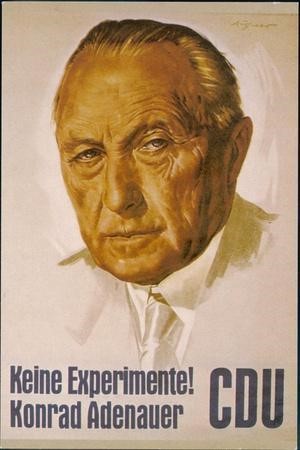
The leader of the CDU, Konrad Adenauer, instinctively smelled that SPD’s untrustworthiness had something to do with its Marxist heritage. Did not all ways of Marxism lead to Moscow, the very antipode of the civilised Western world with its refreshing breeze of Atlanticism? This suspicion was confirmed by SPD’s initial insistence on the German Sonderweg to German neutrality and reunification, and by its unwillingness to adjust to itself the position of CDU in matters of cooperation with West Germany’s Western allies.
Fortunately, in the late 1950s there was a growing awakening within the SPD that a new era had broken, that the party had to think more about its reputation within the German political class in Bonn and West-Berlin, and less about its dusty promises to the German working class. The party was ready for a much-needed facelift to make itself presentable in the new self-confident Germany of the Wirtschaftswunder.
Throwing the Marxist garbage overboard was the least painful part of the rebranding of the SPD. Marxism had ceased being an applied doctrine and living expression of the spirit of the core cadres of the SPD already in the days of Franz Mehring. Removing Marxism from the party was hardly more dramatic or controversial than the decision to remove it from the party programme in Godesberg 1959.
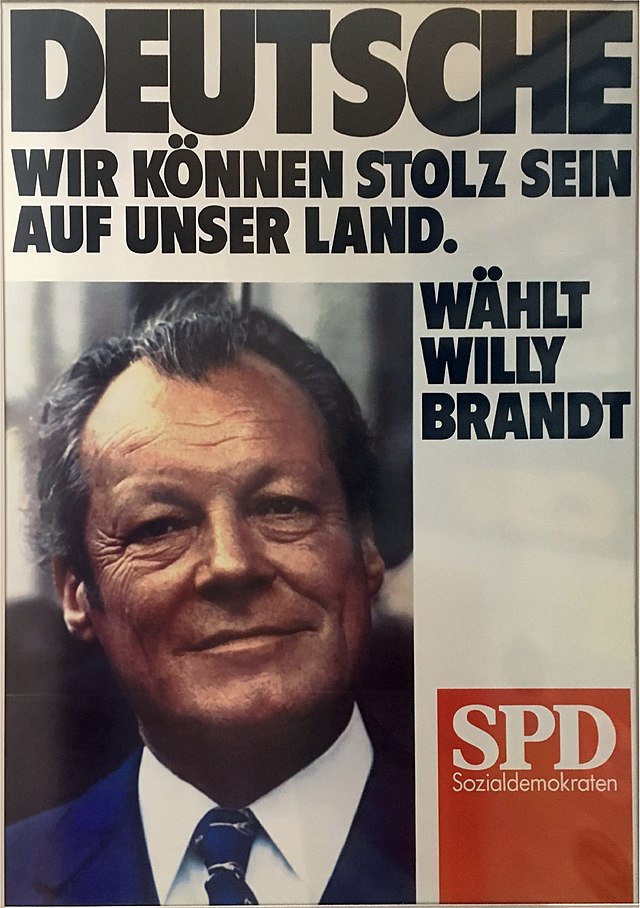
SPD’s reorientation from patriotism to Atlanticism was almost as easily settled by a formal declaration in the Bundestag the following year.[i] Making SPD a living embodiment of the Atlanticist spirit was a much more difficult problem, which would have remained irresolvable hadn’t it been for SPD’s fortune to have, within its top-ranks, a politician that made this new spirit alive in his very own person. This politician was the already world-famous Willy Brandt, the young mayor of West-Berlin.
Willy Brandt was well-known and well-received by the American public, also being a personal acquaintance of president Kennedy. More important, he had a reputation as a champion of Western values in one of the hottest trenches of the cold war: Berlin. Questioning Brandt’s real-world merits as a cold-war-warrior was not possible without openly slandering him – a risky endeavour.
Brandt’s refulgent entrance on the political scene of Germany and the world was more than evidence enough to prove that it now was safe for any aspiring member of the West German political class to join the cadre of the SPD, without damaging the prospects of a political career. Formally this was confirmed by SPD’s ostensive entrance into its first coalition government ever with the CDU in 1966.
Finding Brandt in the coalition government, as its foreign secretary, was almost expected. More surprising and almost shocking was to rediscover the immortal spirit of German national unity reborn in no one other than this new foreign secretary, who recently had made himself a living testimony of the sincerity of the Atlanticist turn of the SPD. Reborn not just as an expression of the old national self-interest, but with a new awareness of Germany’s war-time guilt and a desire for absolution and reconciliation.
Harbouring warm feelings and noble desires within one’s chest is one thing; acting on them and turning them into Realpolitik is quite another thing. Brandt’s newfound ideal desire for one German nation translated to a real-world recognition of the existence of two German states and hence also the communist German Democratic Republic (DDR) together with its eastern borders to Poland. Now it was Brandt’s turn to be questioned and given a cold shoulder not only by the CDU, but also by his former Atlanticist friends within the SPD.
However, the West Germany of Brandt was no longer the West Germany of Adenauer. In the late 1960s Germany had, once again, become a question, a question asked by West Germany’s guilt-conscious young post-war generations. Brandt’s fortune was that his new pragmatic Ostpolitik readily presented itself as a secular answer to a question of almost theological dimensions that CDU had failed to address, in spite of its Christian pedigree.
The margin between question and answer had the effect of loosening the straightjacket of West German political discourse and blurring the line between the secular and the sacral, which suited PDF perfectly and straightened the way for the party in its role as West Germany’s kingmaker. With an accountant’s sense of the economic significance of Brandt’s Ostpolitik, the FDP and its leader Walter Scheel made it possible for Brandt to launch it as the official foreign policy of the new 1969 coalition government between SPD and FDP.
The foreign policy of the new government could almost immediately register diplomatic successes, marked and sealed by the signing of the treaties in Moscow and Warsaw 1970, in which West Germany recognised Poland’s western borders. In hard economic terms, this meant that the embargoes against West German industrial exports to the Soviet Union could be removed or relieved.[ii] For instance, West German industry could now start exporting pipelines in return for natural gas.[iii]
Unsurprisingly, these results were favourably received by the Federation of German industries (BDI) and by big corporations like Krupp, IG-Farben, GHH, Mannesmann, Siemens, BASF, etc.[iv] In fact, a liberalisation of West German trade with Eastern Europe was on its way already before the installation of the SPD-FDP government, which also was supported by the BDI. However, none of it made the CDU any less negative in their attitude to Willy Brandt and his Ostpolitik. Pomerania, Silesia, and a large part of Brandenburg had been sold out in return for cheap economic returns. The CDU appeared out of touch with both the public opinion and the political class of West Germany and its ruling class writ large.
Though it was argued that Brandt’s government was playing to the tune of the Soviet Union and Leonid Brezhnev, who had initiated a policy of détente after the invasion of Czechoslovakia,[v] none of its foreign policies would have been possible without the support of the US administration and indirectly also the Atlanticist interests it seemed to defy.
Already in the mid-1960s, prominent Atlanticist advisors, like Zbigniew Brzezinski, had started outlining proposals for a new cooperative policy with respect to Eastern Europe that was deemed more effective than the previous embargo policies.[vi] In the light of these suggestions, CDU’s opposition to Brandt’s Ostpolitik made the party look more like a liability than an asset.[vii] Confrontational policies and embargoes from the time of the building of the Berlin Wall were no longer thought effective in the late 1960s, as the US grew weary of the Vietnam war and Richard Nixon launched his détentist policies with respect to the Soviet Union and the Peoples Republic of China.
The fact that Ostpolitik easily survived the resignation of Brandt 1974, and hereafter was met with mostly nominal resistance by the CDU, was proof that the Atlanticism of the German political class had matured and was strong enough to strike a balance between Western alliance obligations and economic interests in Eastern Europe and the Soviet Union. It not only survived under the governments of Helmut Schmidt 1974-1982, but asserted itself in the midst of Jimmy Carter’s roll back of Nixon’s détentism. It even survived the hard blows delivered by the Soviet Union, as it started deploying SS-20 missiles in 1976 and invaded Afghanistan in 1979. West German-Soviet trade deals thrived, and German pipelines kept being exported in return for Soviet gas.[viii]
Tensions between common Atlanticist interest and the particular desires of German trade and industrial capital grew, however, without evolving into an open contradiction between the goals of Atlanticism and Ostpolitik, at least not within the ranks of the political class in Bonn. Two outer factors may have contributed to this result: first Schmidt’s decision to initiate and support the deployment cruise missiles and Pershing missiles in West Germany; secondly the US decision to use the tactics of hybrid warfare against Soviet forces in Afghanistan, rather than relying on Western embargoes and economic warfare.
In the 1980s, West German trade and credits were also more frequently funnelled to East Germany rather than the Soviet Union, which deepened tensions between Moscow and East-Berlin. The new CDU-FDP government headed by Helmut Kohl had thus remastered the Ostpolitik of SPD and showed how it could help to undermine Soviet dominance in Eastern Europe, in accordance with the overall ends of the foreign policies of the administration of Ronald Reagan.
Kohl’s Ostpolitik would never have accomplished the reunification of Germany on its own hand, without the popular protests in East Germany and Mikhail Gorbachev’s readiness to treat it as an intra-German affair. However, Kohls Ostpolitik made it easier for West Germany to swiftly absorb East Germany and bring it into the Western sphere. Never had West German Ostpolitik been so victorious as in the moment when it seemed to serve the ends of Atlanticist policies the most.
Notes
[i] The speech was delivered by the leader of SPD in the Bundestag, Herbert Wehner, ironically a former militant communist.
[ii] Michael Kreil, ”Ostpolitik und ökonomische Interessen ”, in Egbert Jahn, Volker Rittberger, ed., Die Ostpolitik der Bundesrepublik: Triebkräfte, Wiederstände, Konsequenzen, Opladen 1974, pp. 72-75.
[iii] Angela Stent, Russia and Germany Reborn: Unification, the Soviet Collapse, and the New Europe, Princeton/New Jersey 1999, p. 22.
[iv] Kees van der Pijl, The Making of an Atlantic Ruling Class, London/New York 2012, pp. 252-253; Michael Kreil, “Ostpolitik und ökonomische Interessen”, in Egbert Jahn, Volker Rittberger, ed., Die Ostpolitik der Bundesrepublik: Triebkräfte, Wiederstände, Konsequenzen, Opladen 1974, pp. 74-75.
[v] Angela Stent, Russia and Germany Reborn: Unification, the Soviet Collapse, and the New Europe, Princeton/New Jersey 1999, pp. 19-20.
[vi] Kees van der Pijl, The Making of an Atlantic Ruling Class, London/New York 2012, p. 253.
[vii] Ibid.
[viii] Angela Stent, Russia and Germany Reborn, Unification, the Soviet Collapse, and the New Europe, Princeton/New Jersey 1999, p. 27.